
How do we use “in”, “on” and “at” for places?
Basic Explanation
Note: For most nouns, we can use “a”, “the” or another determiner after the preposition. It depends on the sentence and context.
in
Generally speaking, we use “in” if the thing or person is inside or surrounded by something.
For example:
- in a box
- in a cup
- in a pocket
- in a drawer
- in a room
- in a house
- in a building
- in an apartment
- in a castle
We also use “in” for some places outside.
For example:
- in a garden
- in a forest
- in the city centre
Even though these places are outside, there is still the idea of being surrounded by something.
We use “in” for many geographic locations, like towns, regions, states, countries, etc.
For example:
- in Paris
- in California
- in France
- in the mountains
- in the city
- in the country
Note: You can say “in the countryside”, but normally we just say “in the country”.
It is usually used for flat printed things.
For example:
- in a picture
- in a book
- in a photo
- in a newspaper
- in a magazine
- in a letter
Example sentences:
- There is still some coffee in the cup.
- My keys are in my pocket.
- I saw Frank peeing in the garden.
- She lives in Paris, which is a city in France.
- They spent the weekend in the mountains.
- How many people are in this picture?
- I know it’s true because I read it in a book.
on
Generally speaking, we use “on” for surfaces.
For example:
- on a couch
- on a table
- on a T-shirt
- on a wall
- on the floor
- on the ground
- on the ceiling
- on the door
- on the roof
Although we say “in a building”, we use “on” for the different floors:
- When I lived in Paris, I lived on the sixth floor with no elevator.
There are also some geographic locations that we usually use “on” for.
For example:
- on an island
- on the coast
- on a farm
Note: In some contexts, we can say “at a farm” as well.
We use it for the words “right”, “left” and “side”.
For example:
- on the left
- on the side
- on the right side
- on the right-hand side
Note: In some contexts, we can use “at the side” as well.
Example sentences:
- The lamp is on that table.
- You have a stain on your T-shirt.
- George likes to sleep on the floor.
- Frank doesn’t really like people, and would prefer to live alone on an island.
- Sydney is on the east coast of Australia.
- In Australia, we drive on the left.
- In other words, we drive on the right side of the road.
Note: “Right” can mean the opposite of “left” or “correct”.
at
We usually use “at” to indicate a general location. The thing or person might be inside the place, or very close to or next to the place.
For example:
- at the library
- at the cinema
- at the bus stop
- at the traffic lights
- at the door (This means on the floor very close to the door.)
- at the window (This means very close to the window, probably on the window sill.)
- at the beach
Note: We can say “on the beach” if we mean on the sand. - at the park
Note: We can also say “in the park”.
We also use “at” for events.
For example:
- at a party
- at a concert
- at a wedding
- at a seminar
Sometimes we use “at” immediately before the place (without an article or other determiner).
For example:
- at work
- at school
- at college
- at university
- at home
Note: “Home” is a bit special. If you use verbs like “be” or “stay”, “at” is optional. So you can say:
- I was at home all weekend. Or: I was home all weekend.
But if there is an activity, you need “at”:
- I used to go to the gym, but now I exercise at home.
Example sentences:
- George waited at the bus stop.
- Somebody is at the door.
- There’s a cat at the window.
- She stopped at the traffic lights.
- Frank got drunk at the party.
- They’re studying law at university.
- I’m at work right now.
More Details
Let’s now look at some more specific rules.
Buildings – in, at
We use “in” when we are surrounded by something or when we are in an enclosed space. That means that we can use “in” if we are inside a building.
BUT we often use “at” for buildings and outdoor places as well.
For example:
- in/at a restaurant
- in/at a supermarket
- in/at a park
Normally, “at” is more general. For example, if you say “I’m at the restaurant”, it might mean that you are inside, or that you are outside, but very close to the restaurant (you might be in the parking lot). If you say “I’m in the restaurant”, it means that you are definitely inside.
We usually use “in” for things inside a place.
For example:
- There are 30 tables in the restaurant.
BUT we usually use “at” if we are talking about where an event or action takes place.
For example:
- We had dinner at the restaurant.
- George used to work at a restaurant.
This rule also applies if we are talking about somebody’s home.
For example:
- There are lots of cockroaches in John’s house.
BUT:
- I do not want to stay at John’s house.
In some situations we use “in” immediately before the location (without a determiner).
For example:
- in hospital
- in prison/jail
BUT “in hospital” means that the person is a patient. If you say “in the hospital” or “at the hospital”, it is not clear. The person might be a patient, but they could also be a visitor or someone who works there.
Compare:
- Did you know that Kate was in hospital?
And:
- The doctor works at the hospital two days a week.
Similarly, if you say “in prison/jail”, it means that the person is being held there. In other words, they are a prisoner. If you say “in the prison/jail” or “at the prison/jail”, the person might be a visitor or an employee there.
Compare:
- Frank spent a night in jail.
And:
- Frank works at a jail.
A similar rule applies to educational institutions (like schools, colleges and universities). If you say “at school”, it means that the person is a student there, or possibly a teacher. If you say “at the school”, the person might be a visitor or an employee there.
Compare:
- My dad called me when I was at school yesterday.
And:
- I work as a gardener at the school near the park.
You can also say “in school”, but the meaning is a bit different. “In school” means being enrolled or attending as a student. “At school” usually means being physically present there.
Note: Some people use “at school” for both meanings, especially in the UK and Australia.
Like for the general rule for buildings, “in the school” means physically inside the school building.
Compare:
- My daughter’s only four years old, so she’s not in school yet.
- I had a part-time job when I was in college.
And:
- There are 25 classrooms in the school.
Food and liquids – in
We use “in” to talk about the contents of food or liquids:
- There is a lot of fat in doughnuts.
- Are there raw onions in that salad?
- There isn’t much alcohol in light beer.
Islands – in, on
As mentioned above, we use “on” before “island”:
- There aren’t many people living on Hamilton Island.
However, if the name of the island does not have the word “island” in it, we usually use the preposition “in”:
- She spent two weeks in Bali.
North, south, east and west – in, on
We use “in” if we use “north”, “south”, “east“ or “west“ as a noun:
- Tasmania is in the south.
- Newcastle is in the north of England.
If we use these words as adjectives, we choose the preposition based on the noun:
- Sydney is on the east coast of Australia.
- They live on the west side of the river.
Transport – in, on
Generally speaking, we use “on” for forms of transport.
For example:
- I’m on the plane.
- She met her husband on a bus.
- Frank got arrested on the train.
We can say “in the plane/bus/train”, but we usually only say it if we want to emphasise that the person or thing is inside and not outside.
We also say:
- on a ship
- on a boat
However, if it is a small boat, especially if it is something like a canoe or a rowboat, we usually use “in”:
- When I was on the lake in my boat, a bird pooped on my head.
We also say:
- on a bicycle/bike
- on a motorbike
- on a horse
The main exception for forms of transport is cars and things that are similar to cars. We say:
- in a car
- in a taxi
- in a van
- in a truck
If you say “on a car”, it refers to the outside surface of the car. You might say:
- There were lots of leaves on my car because I left it under a tree for several hours.
On the topic of transport, we usually say:
- at the airport
- at the (bus/train) station
Like for the general rule for buildings, “in the airport/station” is also possible, but it means physically inside the building.
Streets, roads, etc. – in, on, at
For streets (and words like “road”, “avenue”, etc.), we usually use “on”:
- There are lots of pubs on George Street.
We can also use “in” for streets:
- There are lots of pubs in George street.
However, if there is a number before the street name, we use “at”:
- There’s a good pub at 110 George Street.
Water – in, on, at
If the thing or person is surrounded by water, we use “in”.
For example:
- I saw Frank swimming in our neighbour’s pool.
- There are lots of fish in this river.
- There is a small island in the lake.
However, if the thing or person is on the surface of the water, we usually use “on”:
- There are lots of boats on the lake.
But we can also say:
- There are lots of boats in the lake.
If the thing or person is not in the water, but close to the water, we usually use “at”:
- I’m going to have a picnic at the lake.
You can also use “at” to speak in general terms, especially if you do not know the exact location or if it is not important.
For example, if someone asked me: “Do you know where George is?”
I could answer: “Yes, he’s at the local pool.”
I do not know if right now as we speak he is swimming, lying next to the pool or in the parking lot, but I know that he went to the pool.
Printed and digital things – in, on
Usually we use “in” for printed and written things (like pictures and letters), but for some things we use “on”.
For example:
- on a map
- on a menu
- on a list
- on a page
If you are talking about a specific page in a book or newspaper, you can say:
- on page (the number)
For example: The picture is on page 10.
When we are talking about paper, it depends. If we are talking about information from a newspaper or research paper, we use “in”:
- I know it’s true because I read it in the newspaper.
If we are talking about a physical sheet of paper, we use “on”:
- There are marks on this paper.
Examples of digital things:
- on a webpage
- on a website
- on the internet
- in an email
- in a document
- in a file
Top, bottom, front, back – in, on, at
For these words, we use “at” when referring to a position or general area.
For example:
- She is at the top of the hill.
- We waited at the bottom of the stairs.
- He stood at the front of the room.
- The dog is at the back of the house.
We use “in” when a thing or person is inside an area or part of something.
For example:
- “There’s a crack in the top of the table.” (in the material)
- Water collected in the bottom of the boat. (in the lower section)
- The kids sat in the front of the car. (on the front seats)
- They’re sitting in the back of the classroom. (inside the back section)
Note: For rooms, “at the back” is also common.
We use “on” when a thing or person is touching or attached to a surface.
For example:
- The book is on the top of the cupboard.
- There’s a label on the bottom of the box.
- The logo is on the front of the shirt.
- There’s a pocket on the back of the jacket.
Corners – in, on
Look at these pictures.

in the corner
(Again, there is the idea of being surrounded by something.)
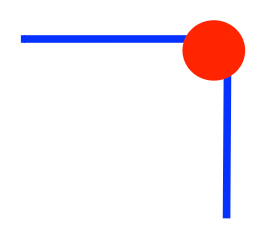
on the corner
Example sentences:
- There is a small table in the corner of the room.
- There is a pub on the corner of our street.
Note: It is less common, but you can also say “at the corner of our street”.